
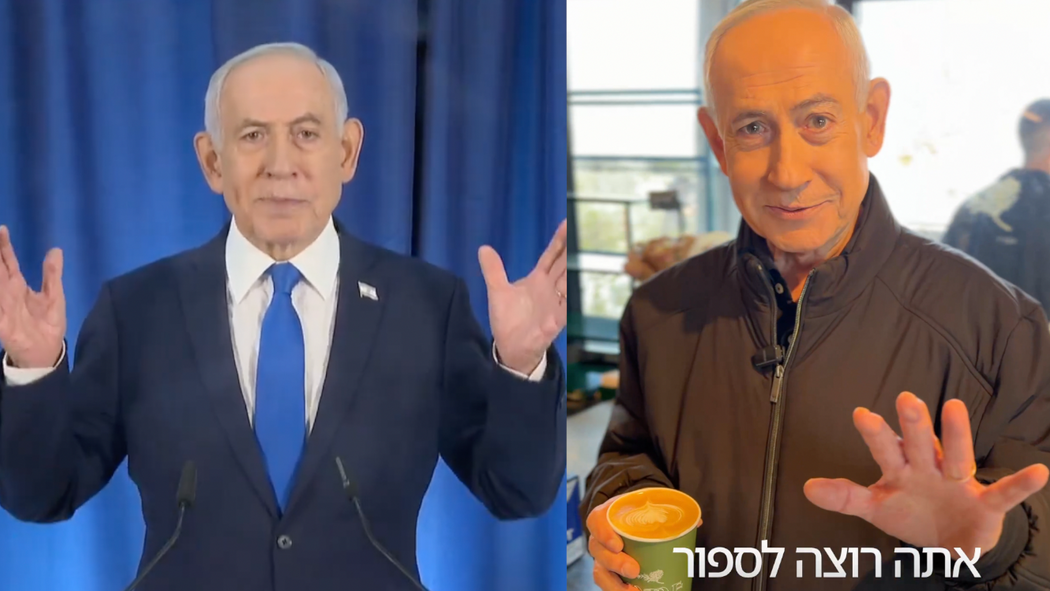
Claims circulating on social media suggesting that Benjamin Netanyahu has died have been firmly denied, with the Israeli leader appearing in a video to prove he is alive.
The rumours emerged amid ongoing tensions involving Israel, the United States, and Iran, following military actions that began on 28 February. Since then, Iranian state media and pro-government accounts have circulated false reports claiming that Netanyahu and other senior Israeli officials had been killed.
Addressing the speculation directly, Netanyahu shared a short clip on social media with a caption challenging the rumours. In the video, he humorously responded to claims of his death by joking about his love for coffee and expressing pride in his people. He also raised his hand to the camera, seemingly to counter earlier online claims that questioned the authenticity of previous footage.
The conspiracy theories gained traction after a speech he delivered on 12 March, where some users alleged the video had been generated using artificial intelligence. These claims were fueled by low-quality footage that appeared to show an unusual number of fingers on his hand. However, higher-quality versions of the video clearly show five fingers, confirming that the distortion was caused by lighting and image quality rather than manipulation.
To further disprove the rumours, Netanyahu’s café appearance was traced to a real location in the Jerusalem Hills, where he was seen visiting a local coffee shop. The venue itself shared images and videos of the visit, supporting the authenticity of the footage.
Despite these clarifications, misinformation continued to spread. Some social media users, along with automated tools like Grok, incorrectly labeled the video as a deepfake. Experts have cautioned against relying on such tools, noting that they often misinterpret normal human behavior as artificial due to statistical anomalies.
Verification specialist Tal Hagin explained that AI detection systems are not always reliable, as they base conclusions on probabilities rather than confirmed evidence. He emphasized that unusual gestures or camera distortions can easily mislead such systems.
Additional claims suggested the video was old, pointing to details like face masks worn by security personnel. However, these guards belong to the Shin Bet, whose agents sometimes wear masks to conceal their identities, regardless of public health concerns.
The spread of these false reports is not limited to Netanyahu. Other Israeli officials, including David Barnea, have also been falsely reported dead online. In Barnea’s case, unrelated footage from a past incident was misrepresented as evidence.
Overall, the situation highlights how quickly misinformation can spread during times of conflict, especially when amplified by social media, political agendas, and unreliable verification tools.