
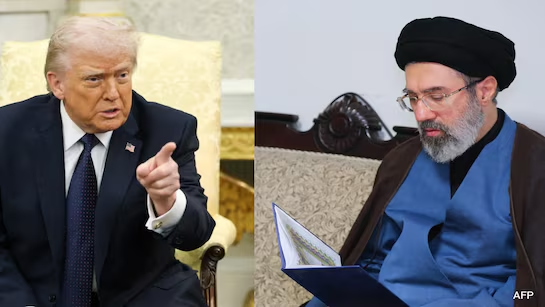
Iran has selected a new Supreme Leader following the death of Ayatollah Ali Khamenei, who was killed last weekend during coordinated military strikes carried out by the United States and Israel. The country’s leadership body, the Assembly of Experts, has chosen Mojtaba Khamenei, the son of the late leader, to take over the highest political and religious position in the Islamic Republic.
Mojtaba Khamenei, who is 56 years old, had long been considered one of the most likely candidates to succeed his father. However, questions remain about how long he may remain in the role, especially as U.S. President Donald Trump has openly criticized his appointment and described him as an “unacceptable” choice.
Mojtaba Khamenei was born in 1969 in the city of Mashhad, about a decade before Iran’s 1979 Islamic Revolution that transformed the country into an Islamic Republic. After the fall of the Shah, his family relocated to Tehran. During his younger years, he also participated in the Iran-Iraq war, which lasted throughout the 1980s.
Over time, Mojtaba Khamenei became an increasingly influential figure within Iran’s political system. After his father assumed the role of Supreme Leader in 1989, Mojtaba was widely viewed as playing a significant behind-the-scenes role in the country’s leadership. Some diplomatic reports previously described him as a powerful figure within the regime who could potentially inherit a share of national leadership.
In addition to his political connections, Mojtaba studied with prominent religious scholars in the Iranian city of Qom, a major center for Shiite Islamic education. These studies helped him build relationships with influential clerics, many of whom are considered part of Iran’s conservative and hardline religious establishment. Support from these figures contributed to his rise as a leading candidate to succeed his father.
Despite his appointment, his leadership has already drawn criticism from Washington. President Donald Trump said that Mojtaba Khamenei would need approval from the United States if he hopes to remain in power for long. According to Trump, any leader who fails to gain acceptance from his administration could face serious consequences.
Trump also stated that he wants to ensure Iran’s future leadership will promote peace and stability rather than continuing the policies of the previous regime. He argued that the United States should have a role in shaping the process that determines who leads Iran.
At the same time, the U.S. president indicated that he might be willing to accept a leader connected to Iran’s existing political structure if that individual were capable of leading the country in a more stable direction. However, he has repeatedly expressed strong criticism of Mojtaba Khamenei personally.
Trump also claimed that several individuals who had been considered potential leaders of Iran were killed during the recent military campaign. U.S. officials have said that the primary objective of the operations against Iran has been to weaken its nuclear program and naval capabilities rather than directly pursuing regime change.
The conflict in the region has continued to escalate since the strikes that killed the former Supreme Leader. Iran has launched retaliatory attacks against Israel and several Gulf countries that host U.S. military forces. These strikes have targeted locations in Kuwait, Qatar, the United Arab Emirates, and Bahrain.
Within Iran itself, political tensions have also emerged. Iranian President Masoud Pezeshkian recently faced criticism from hardline political figures after apologizing in a televised speech for retaliatory attacks carried out against neighboring countries. Some conservative leaders viewed the apology as inappropriate during a time of conflict.
One hardline cleric and member of parliament publicly criticized the statement, calling it weak and unacceptable. He argued that Iran’s leadership must remain firm and quickly confirm a new Supreme Leader in order to protect the legacy of the Islamic Revolution and maintain political stability.
President Trump has also encouraged Iranian citizens to challenge their current government once the military operation ends. He stated that the Iranian people should take control of their own political future.
Reactions to the situation have varied internationally. Some political leaders have argued that it is not the responsibility of the United States to determine who should lead Iran. Others believe that outside pressure may influence the country’s political direction.
Military and security experts have also warned about the risks of attempting to change a government through military force alone. Some analysts have pointed out that airstrikes and military pressure rarely lead directly to regime change without additional political or internal developments.
As Iran enters this new phase under Mojtaba Khamenei’s leadership, the country faces significant challenges. Ongoing conflict in the region, internal political disagreements, and international pressure are all expected to shape the future of the Islamic Republic in the months ahead.